Poimandres: The Hermetic Text That Begins With One Question
Watch the video: https://www.youtube.com/watch?v=a9tOv0RIRJM
Free guide 03, The First Question (PDF, by email): https://bjj-yoga.com/the-slow-initiation/?guide=03
A being of unlimited size calls your name, and asks you one question. Not “who are you.” Not “are you ready.” He asks: what do you want to hear, to see, to learn, and to know?
That is how the oldest Hermetic text I know begins. I think most of us answer that question badly, or never answer it at all.
I’m Rodrigo, and this is The Slow Initiation: foundations before mysteries. Here is the plan. First, the opening scene, slowly. Second, what scholars do and do not know about where this text comes from, and my own opinion. Third, a one-minute practice for tonight.
What the Poimandres is
The Corpus Hermeticum is a collection of Greek texts written in the first centuries of our era, in the Greek-speaking world of Egypt. They are presented as teachings of Hermes Trismegistus, the thrice-great Hermes. The first treatise, the Poimandres, is not a lecture. It is a story, a vision.
I tell it here in plain modern English, staying close to the 1906 translation by G. R. S. Mead (public domain). Mead writes with thee and thou; I put it in modern words so anyone can follow.
The opening scene
The narrator is anonymous here; another treatise says he is Hermes. He tells us that his thought was lifted up and the senses of his body were held back, like someone heavy with sleep after a big meal or a long day.
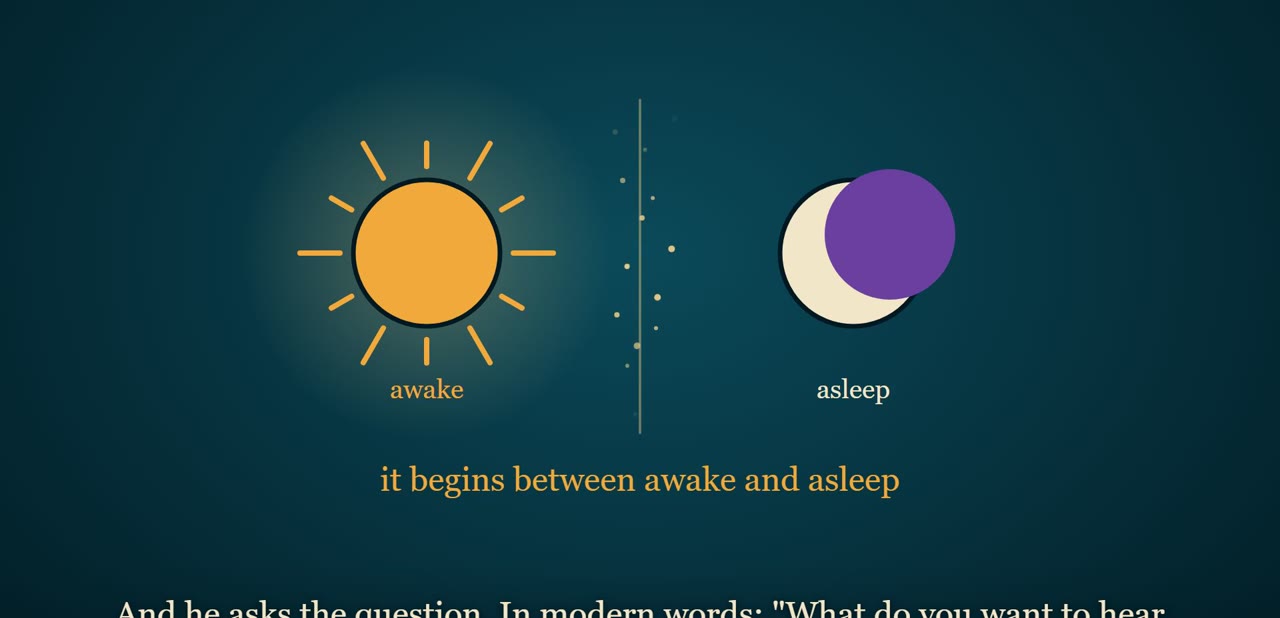
Stop here for a moment. This text does not begin in a temple, with a ritual, a mountain or a secret society. It begins in a state between being awake and being asleep.
Then an enormous being appears, without limits, and calls the narrator by his name. In modern words: “What do you want to hear and see? And what do you have in mind to learn and know?”
The narrator does not answer. He asks back: who are you? “I am Poimandres, the Mind. I know what you desire, and I am with you everywhere.” Only now does he say what he wants: to learn about the things that are, to understand their nature, and to know God. And Poimandres answers: “Keep in mind everything you want to know, and I will teach you.”
Right after that, everything opens: a vision without limits, all things turned into light, then a darkness, then a long and strange story about how the world and the human being came to be. I will not walk through all of it today. I want to stay at the door.
The order of things
The strangest thing in this scene is what the being does not do: he does not give an answer first. Look at the order. First, the narrator is in a state where he is not grabbing at the world. Second, a presence asks him what he wants. Third, he has to say it out loud. Only then does the teaching start, and the teaching is shaped by the question.
This is my reading; I am not saying the text says it in these words. But I think the text puts the question before the doctrine: before the laws, before the powers, before the mysteries. First: what do you want?
And notice the second instruction: keep in mind everything you want to know. It is not enough to say the wish once. You have to hold it, quietly, while the answer takes its time. With a phone in our pocket, most of us ask a question and ten seconds later have opened something else. To hold one question for a day, or a week, is already unusual, and a very good training for the mind.
It matters because the question quietly decides what you will find. Someone who asks “how do I get what I want” walks into one library. Someone who asks “what is real” walks into another. Someone who asks “how do I look advanced” walks into a third. All three can read the same book and come out with three different books.
My own honest answer today: I want to keep learning, and to share what I have learned. The more I learn, the more I feel I have not touched the beginning of the mystery. A real wish does not close the subject; it opens it. We never finish. On this channel I put myself on the same level as you: I am studying, learning and evolving, just like the person who is watching. I am only sharing what I find along the way. And I may be wrong.
Four verbs: hear, see, learn, know
Four verbs, not one. I read them as a small staircase.
- Hear and see: to receive. Something comes to you from outside, a word, an image.
- Learn: to work with what you received. To go back to it, test it, get it wrong.
- Know: when it is no longer information. It has become part of how you live.
Most of us stop at the first two. We hear a lot, we see a lot, we watch videos like this one, and we feel that something happened. But hearing and seeing are the bottom of the staircase, not the top. That is also why this channel is called slow: a staircase is climbed one step at a time.
Three borrowed answers
Very often we answer the question with a wish that is not ours.
- The wish of the crowd: I want what the people around me say is worth wanting.
- The wish for power: I want the secrets, so that I can control something.
- The wish for a label: I want to be called an initiate, a teacher, an awakened person. (The same old mistake: identifying with an image.)
None of these is about the thing itself; they are about what the thing will do for me. A real question points at the thing: what is this, how does this work, what is true here? And you can feel the difference. A borrowed wish is tense and wants it fast. A real wish is patient and can wait. That is the first filter this text gives us, before any teaching: check if the wish is yours.
Where does it come from?
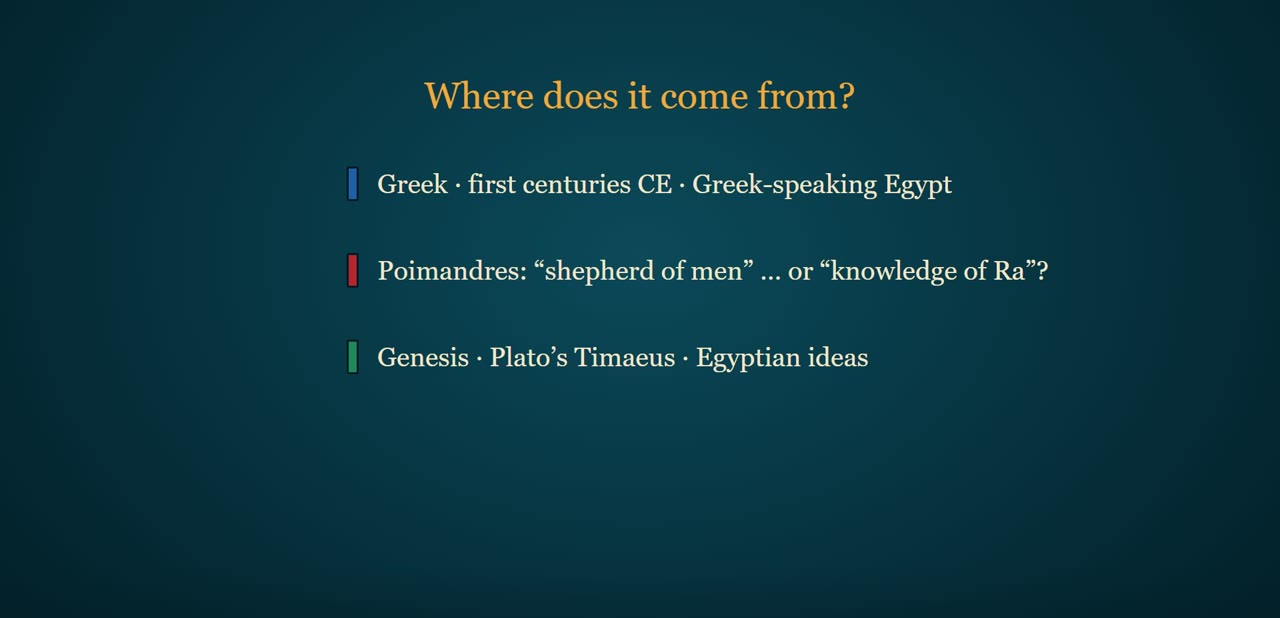
The honest answer is that we do not know who wrote it. It is Greek, from the first centuries of our era, from the Greek-speaking world of Egypt. That is about as far as certainty goes.
- The name is a puzzle. Poimandres is traditionally read as “shepherd of men.” Some modern scholars suggest an Egyptian phrase, something like “knowledge of Ra.” A proposal, not a proof.
- The creation story inside the text is an open debate. Some researchers see strong parallels with Genesis, even in some wording; others see Plato’s Timaeus and Egyptian ideas. Walter Scott (English translation with notes, 1925) argued there was little or no Jewish contribution. A 2025 article says the Genesis parallels are too strong to ignore, and a 2025 doctoral thesis from Madrid argues that the treatise was built following how Jewish readers in Alexandria interpreted Genesis.
- For a long time people believed this text was far older than it is. Renaissance thinkers read it as very ancient wisdom, and that belief shaped how the West read it for centuries.
Egyptian, Greek, Jewish, Platonic: perhaps all of them. Nobody can close the case, and we can read it honestly without closing it.
My opinion, and the border
Is it a revelation, an allegory, a piece of literature built from other texts? Honestly, I have no idea. I think it is probably an allegory, and I do not think it changes much. Many stories are written as fiction and still carry a deep message. We tend to make some texts sacred and call others entertainment, but maybe a song or a novel can also be something received, and not only made. I do not say this as a fact; it is a possibility I keep open.
I say it because of how my own ideas arrive. For me the most revealing moments are on the border: just before I wake up and just before I fall asleep. That moment is very short and very long at once. The best ideas I have, insights, songs, compositions, come there. They feel like downloads I receive. I am not saying the ancient author lived what I live. I only notice that this text also puts its vision at that border.
I write these things down, with a rule: write first, interpret later. An idea that arrives ready is not proof that it came from outside; a message can surprise the person who receives it and still be born inside that person. The opposite mistake exists too: throwing an idea away because it came too easily. I do not need to decide right away. For me, thinking for yourself does not mean rejecting what came before; it means not outsourcing your judgment. I do not need to know who wrote the Poimandres to ask what it is asking me.
One last detail I like: unlike other texts of the Corpus, here the narrator does not stay inside the vision. Scholars point out that after his experience he goes out into the world to preach what he received. The question that opens the text ends as a task. I do not read it as “go and convince others.” I read it as: knowing has to come back to the street, to how you treat people, how you work, how you rest. A vision that does not change how you treat people is only a nice night.
A bridge to yoga
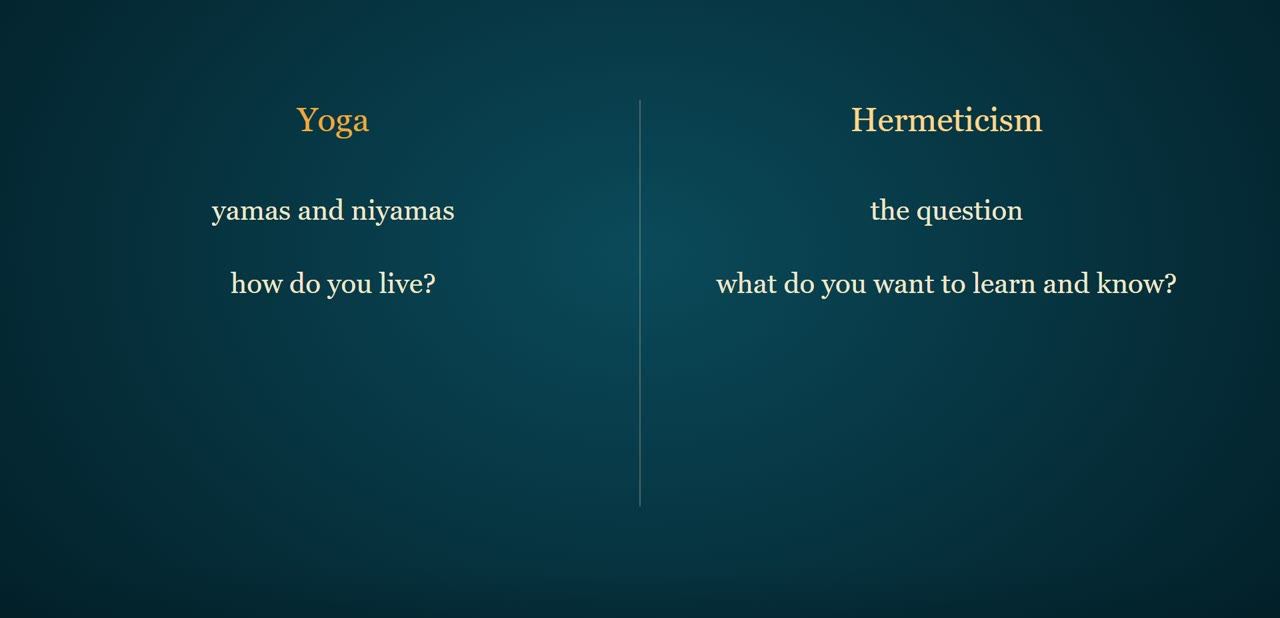
In yoga, before the poses and the powers, there are the yamas and the niyamas: how you treat others and how you treat yourself. They are questions too, in a way. In Hermeticism, before the laws and the mysteries, you are asked: what do you want to learn and know? Last time I said the first step is not a law, it is a letting go (the previous video). This is the other half of the same foundation. Letting go means seeing what is in the way; the question means saying what you are walking toward. The first foundation, in both traditions, is honesty.
The practice (one minute a night, for a week)
Not a technique, just a way of being asked.
- Tonight, before you sleep, take a pen and paper. Not your phone.
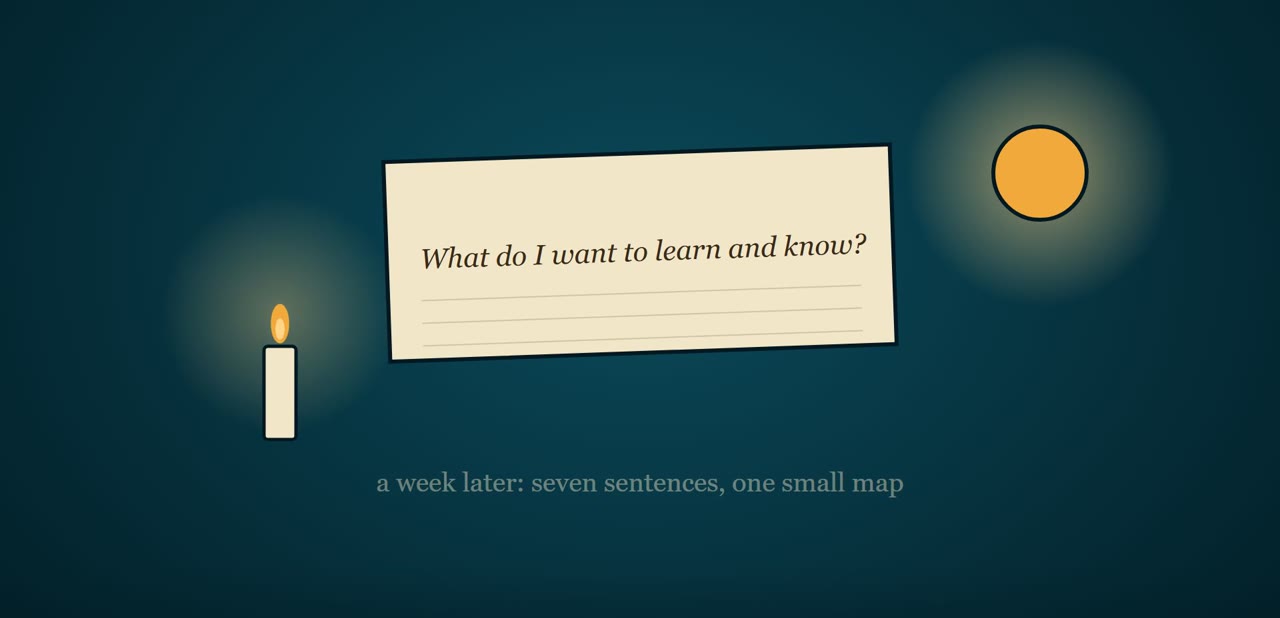
- Write one sentence: What do I want to learn and know? Not what you want to have, not what you want to become.
- Look at it. Is it a real wish, or something you think you are supposed to want? If it is not yours, cross it out and write it again until it feels honest.
- Put the paper on the table. That is all.
- In the morning, before the phone, write down the first thing that crosses your mind. Do not judge or interpret it.
- Do this for a week, expecting nothing. You are only practicing being asked.
- At the end of the week, read the seven sentences in a row. Notice which words come back and what you crossed out. That list is a small map of what you really want to know, written by you, not by a book.
Summary
- The Poimandres begins in a state between sleep and waking, with a being who asks one question.
- Nobody knows for sure where it comes from: Egyptian, Greek, Jewish, Platonic. The debate is open, and that is fine.
- Before the laws, the powers and the mysteries, there is a question: what do you want to learn and know? The first step of Hermeticism is not an answer. It is a question.
Free guide 03: The First Question. The scene, the four verbs and the one-week practice on a few pages. Leave your email and I will send it to you: https://bjj-yoga.com/the-slow-initiation/?guide=03
Tell me in the comments of the video: what do you want to learn and know? One sentence is enough.
Sources
- G. R. S. Mead, Thrice-Greatest Hermes, vol. II (1906, public domain): https://sacred-texts.com/gno/th2/th202.htm
- Harvard CSWR, “Corpus Hermeticum I”: https://cswr.hds.harvard.edu/news/2026/02/13/corpus-hermeticum-i
- Brian P. Copenhaver, Hermetica (Cambridge), treatise I: https://www.cambridge.org/core/books/hermetica/corpus-hermeticum-i/A5163B0741264BF34F2555B8C2B9BE4A
- J. MacDaniel-Streibel (2025), “Comparative Cosmogony: Genesis and Timaeus in the Hermetic Creation”, Constellations 16(2): https://journals.library.ualberta.ca/constellations/index.php/constellations/article/view/29566
- Doctoral thesis “Tradición y revelación en Poimandres”, Universidad Complutense de Madrid (2025): https://docta.ucm.es/entities/publication/2df9865b-8c08-4335-ae21-e50f38006857
Readings and opinions are marked as such. Educational content, not medical or therapeutic advice. The narration of the video is an AI voice cloned from the author’s own voice; the script and opinions are the author’s.
A free guide
If you like reading about yoga and the older traditions, I go deeper on my YouTube channel, The Slow Initiation. Leave your email, confirm it, and I will send you a free PDF guide, Yoga Starts Before the Poses. After that you will hear about new videos. Nothing else.
I use your email only for this. You get a confirmation email first, and every email has an unsubscribe link. See the privacy policy.